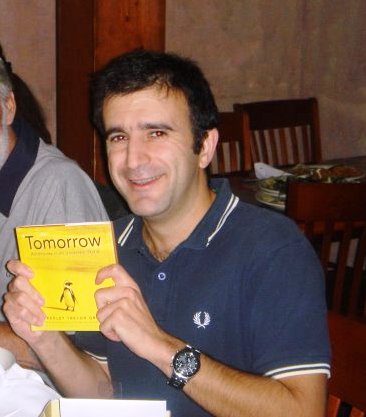
Friday, March 23, 2012
Dallas, I want to tell you a story
Introduction: The e-mail message arrived as a complete surprise from Scott Williford. I’d known him briefly ten years ago and by first name only, when he occasionally repaired my bicycle at the local shop where he worked part time while attending Tennessee Tech. The message was about him and his wife Mindy, whom I’d known for an equally brief interval, and separate from him before they were man and wife.
I’d met Mindy at the gym. I knew she was a student with athletic skills and that she was an expert whitewater paddler who’d been mentioned in a book on that subject. During our short acquaintance she went running with me one day.
Ten years passed, and Scott sent me the message. I’ve since learned they’ve been very successful. Scott owns a sales agency with four employees that represents cycling and running gear across several states. Mindy is the CFO of a hedge fund, and - ever the athlete - she rides her bike to work more than she drives the car. They live in Chattanooga with their cat Leo.
Scott’s message was poignant and expressive and it astonished me. It’s a story about: endurance sport, a small kindness, awakening and transformation, and success. Above all, I think, it’s a love story. It’s pasted below unchanged. My title was his subject line.
Dallas,
I have no idea if you remember me, I spent a few of my college years working at Cookeville Bicycles, around the same time you were deciding it was a good idea to follow a 112 mile bike ride with a marathon. I worked on your bicycle a few times, and always enjoyed listening to your stories. A few weeks ago, I was in Cookeville, and picked up a copy of your book at Brian's store. I didn't realize until I started reading it that it was your second book, so I guess I will have to look for the other at some point.
I very much enjoyed reading your collection of stories, and I thought you might enjoy hearing one of mine, well, actually it is probably more my wife's story than mine.
As you mentioned several times in your book, you have an easy to remember name, as well as an easy to get along with personality. I don't guess I really talked to you all that often, but I always remembered who you were and would see you out running in Cookeville on a regular basis. From reading your book, I believe that I may have actually ran your first race with you, though it would have been before I met you.
Really I want to tell you about my wife. I met this shy girl in college, and immediately fell in love. We met in Cumberland Mountain Outdoor Sports on the square. We were both into whitewater paddling, and fairly quickly had our first date kayaking on the Big South Fork of the Cumberland....in January....in the snow; I knew I had found the right woman! This young woman was just starting to discover that she had the makings of an athlete. I introduced her to rock climbing, cycling, and of course, running. She struggled some at first, but pretty quickly began running almost every day. She ran her first 10k in Cookeville, and was shocked she could actually run that far.
Skip ahead several years, and we both got into triathlon, no IMs at this point, but is probably in our future. From our entry into triathlon, more running races followed, including the 2007 Battlefield Marathon in Chickamauga, GA, which we struggled through together on next to no training in the dismal time of 4:50. From that race, we both knew we had to come back to do better, and set breaking 4 hours as a goal. We came back the next year, I ran a 3:50, she a 3:55. At that point, she began to feel that she could possible qualify for Boston. So, going into the 2009 Battlefield Marathon, her goal was to run 3:40. At the end of the day, her chip time read exactly that, 3:40:00, dead on her goal, 59 seconds to spare.
She ran Boston in 2011, the same year you finished second in your age group. It was our first trip to Boston, and not wanting to ruin a vacation with an all out marathon, she cruised through the course at 3:45.
Here is why I am telling you this story. My wife's name when she met you was Mindy Freeman. I have no idea if you remember her or not, but you took her on her very first double digit run (10 miles) probably sometime around 2002. She was shocked she could make it that far, and I remember talking with her later that day, and saying, I could never have done it without Dallas. She honestly took the confidence she gained from that day with her into our first marathon attempts, and her eventual Boston Qualifier. She refers to her run with Dallas often, and it was obviously a pivotal moment in her life as a runner.
I know for you that taking Mindy out on that run that day was a simple thing, but it had a profound impact on her life, and helped to shape the woman that I love. As I read your book, I realized that there are probably dozens of these stories following you, some you may know about, others are probably like Mindy's.
As we well know as runners, running can help to shape and define your life, and create memories that will last a lifetime. Some of those memories are of great victories, even if most of them are simply personal. You have a collection of awards and records to show your ability as a runner, but the one you deserve the most is one they can't make a plaque for, that you have inspired dozens if not hundreds of people to find something they never knew was inside them. I just wanted to say thank you.
If you are ever down in Chattanooga, feel free to look us up, Mindy can probably keep up with you running, I might have to resort to a bicycle.
Scott
Friday, December 9, 2011
New Book: Going Down Slow

They don't yet have up the Editorial Reviews or the "Inside the Book" feature. Therefore, so that readers who are interested can browse the book a bit more, I'm including the Editorial Reviews and Contents below.
EDITORIAL REVIEWS:
“A legendary runner and master storyteller has triumphed again…But the real victory belongs to the person who reads Going Down Slow…by Dallas Smith, one of the most remarkable athletes on the planet…Whether you’re an accomplished distance runner, [or] an around-the-block jogger…you won’t be able to put this book down. It’s that good…Much of his writing is pure poetry…” Corky Simpson, Green Valley News, AZ
“If Hemingway had been a runner his name would have been Dallas Smith. In his second book, Dallas shows that he is not a runner pretending to write but rather a gangsta of prose wrapping words smoothly around sweaty sneakers and singlets that make you feel as if you were there with him on his running escapades and tales of human compassion.” Joshua Holmes, CEO of Phoenix Publishing, founder of RunItFast.com
“His M.O. combines the relentlessness of a Terminator with the gregariousness of a yearling Labrador retriever. The people he meets confess, vent, advocate, and otherwise reveal their most cherished convictions and thereby obtain a voice to the world…what Smith learns and imparts to the reader is often surprising.” Stan Lawrence, songwriter, mandolin and vocals, Music City Flyboys
“Competitive running probably satisfies many goals for Dallas Smith, but chief among them must be the opportunity to observe humanity in all of its colors and then tell stories about what he saw. It’s the small observations amid lofty thoughts that reveal the soul of this author. Beset with physical and emotional misery after a disappointing marathon in Stockholm, he finds the smile of a stranger brings joy and tenderness to the moment, an experience he links seamlessly to the writing of Saint-Exupery.” Michael Redding, Ph.D., Professor of Anatomy and Physiology, Tennessee Tech University
“Dallas Smith uses his keen observation ability and his endurance running skill to tell wonderful stories…” Diana Bibeau, president of Nashville Striders
“Pour yourself a big glass of wine, throw a few logs on the fireplace, and snuggle up in a comfortable chair. You are about to be entertained by the tales of a master storyteller… This latest compilation…is honest, poignant, and heartwrenching…” Amy Dodson, ultrarunner, two-time ITU World Paratriathlon Champion
“Dallas Smith is a masterful writer and storyteller, illuminating that whole range of passion that now thrills and now torments the human heart…” Charles Denning, former executive editor of Herald-Citizen, TN
CONTENTS:
Prologue—Daddy’s Blue Shoes
I. Turnaround
1. Turnaround
2. Punky Reggae Party
3. The Race No One Saw
4. On the Street Where You Live
5. Miracle on Fall Creek
6. The Best Marathon in the World
7. Twelve Gather for Supper
II. Spirits
8. Momma, Her Supper Table, Christmas
9. Tip Your Hat to These Two Women
10. Katie’s Angel
11. Prairie Chicken Capitol Redux
12. A Lonely Mesa, a Rude Visitor
13. What if a Neutrino Whacked Your Noggin?
14. Weather Report: Seville, Spain
15. The Editor Who Wanted Me to Write Stories
16. The Moment of Inertia
17. Iron Bill, Meet Queen Maeve
18. In My Father’s Garden
III. Pathos
19. I Could See the Midnight Sun
20. Porch Is Gone
21. The Way Angela Runs
22. Ironma’am
23. The Hunter’s Moon
24. Adventures in Paradise
25. Country Music Contrarian
26. Come Home, Hokie
27. I’ll Take Manhattan
28. One Day in Funkytown
29. Summer Heat Reveals Artifact of Marathon Man
30. The Mystery of Water
IV. Pilgrimage
31. She Threw Open Her Golden Gate
32. The Old Slugger Remembered the Long Balls
33. Nobody Wants to Crawl
34. Dispatches from El Camino
35. The Titan
36. Komen – Four Who Ran
37. Wretched Undead Hound the Haunted Half
38. A Special Guest at a Special Race
39. Fourteen Elite Fools
40. After the Flood
Photos
Appendix—My Winning Year
Acknowledgments
About the Author
Wednesday, November 16, 2011
Bad Enough To Be Good

Which started the second night before the marathon, one of the days where you try to load up on carbohydrates. So my stepson, Derek, who lives in Indianapolis and who ran the half marathon, and I went to an Italian restaurant for spaghetti. Spaghetti with meat sauce. That means ground beef. It was a fateful choice.
You may assume ground beef contains cowshit. Cowshit in turn contains E. Coli, a powerful bacterium which will give you a bellyache and diarrhea. Unless, of course, it is thoroughly cooked.
We were not familiar with that particular restaurant, which shall go unnamed. An order of spaghetti there meant a whole bowl of the stuff, enough for three, and that’s what we both ordered. From each bowl, we ate enough for one, and took the rest back to Derek’s apartment for lunch the next day. We never ate that leftover spaghetti, because of what happened next. Derek and I soon began taking urgent turns going to the bathroom. We purged our systems. The helpful effect of all the carbos we should have gotten were thereby lost. Or so I reckon.
Next time I’ll have plain marinara sauce, maybe with mushrooms, but no ground beef.
Second issue. The weather forecast said the temperature at race time would be 33 degrees F. That turned out to be accurate. How to dress became the question. With my skinny frame I radiate heat readily, and get cold easily. Nonetheless I decided to go barelegged, with a long sleeved tee, a runner’s hat, and fleece gloves. I used a heavy throw-a-way flannel shirt to keep me warm while I waited in the corral for the start.
When the race started, I was still wearing that shirt. At sixteen miles I was still wearing it, still needing it. Forecast was for a sunny day. But the sunshine didn’t add much warmth for a good long while. Race started at 8 a.m., and sunrise came at 8:30 (Eastern Time Zone the day before time changed to Standard). The shade of the tall buildings early on and of shaded residential neighborhoods later kept the sun from hitting us. Even wearing the fleece gloves, my fingers nearly froze.
From the beginning my race was not good. By mile six or seven I was already working hard to maintain my planned pace, 7:40 per mile, a pace predicted by a half marathon I’d run just two weeks earlier on a hilly course—whereas the Indy course was flat. The first half of a marathon should be easy. If it’s hard, you know trouble is coming.
It did come. My mile times stretched out. I watched with detached and knowing interest.
Underneath the flannel shirt I had on my most colorful race uniform, a yellow Boston tee with bright blue trim and shorts of matching blue. Yellow shoes and yellow socks made me a bright runner. Nobody could’ve known that—photographers included—because of the flannel shirt, which covered my race bib and made me look like a homeless person. So I resolved to shed the flannel. It ain’t going to get any worse without it, I thought.
I ran up to a woman volunteer at the mile 17 water stop.
“I’m going to do a striptease right here if you’ll help me with the buttons.”
She laughed, and started in. “I can do that.”
“My fingers are too cold.”
“There.”
“I’m donating a shirt to you. It’s like new.” I left her holding the shirt.
Looking professional is important, but it didn’t help my race. Mile times were by then hitting 8:30. Nine was coming, I was losing interest in the race. A jogging pace of 9:30 finally settled in. I didn’t care. Race had gone bust. I was just jogging it in.
After I turned the corned and headed down the stretch, the announcer was saying: “And how about Dallas Smith, 71 years old from Cookeville Tennessee!”
My net time turned out to be 3:44:49, twenty-three minutes longer than the 3:21 predicted by my recent half marathon, and twenty-one minutes longer than my Boston Marathon time of 3:23 seven months earlier.
Oh, the time was good enough to win first place in my decrepit age division. It was even good enough to beat the Tennessee State record for my age. But it was not good, not what I’d call good.
So be it. The marathon is an enigma, and I’ll never figure it out. Hit or miss, every time, it seems. Sometimes things go like I expect, other times not. It’s unpredictable, and I accept that. I think that’s why I like the distance.
Maybe the tainted food hurt my race, maybe it didn’t. Maybe I should have worn tights to keep my running muscles warm, but how can I know if that’s true.
On the other hand, I liked the city.
It occurs to me that you’ve probably never heard anyone say: “Hey, let’s take our vacation and spend a week in Indianapolis.” You can imagine that for New Orleans, or Miami, or even Nashville, say. The day before the marathon, I tweeted: “ The Colts and the 500 comes to mind, but what else is Indianapolis noted for?” Well, it turns out, a lot. The city has more soul than I’d realized.
Monuments are scatted throughout the city, hence the “Monumental” handle. The Indiana War Memorial is nothing short of majestic, especially the inside space where a sacred atmosphere prevails. Downtown, a grand mall of monuments and parks extends from the Courthouse north to the public library, a distance of maybe half a mile. Included are University Park; The Indiana War Memorial; the Bicentennial Mall, with its tall obelisk and fifty state flags; and finally Veterans Mall.
Central Canal runs through the city, decorated by plazas and pedestrian bridges and wide walks, a pleasant location for a casual stroll or a jog.
Crown Hill cemetery, the fourth largest civilian cemetery in the country, is where the poet James Whitcomb Riley is buried. His tomb occupies the top of the highest hill in the City and overlooks the city’s skyline. One could spend a day in that sprawling cemetery viewing the architecture of the mausoleums and grounds.
A Civil War Monument anchors the center of town, a tower 284 feet tall, just fifteen feet shorter than the Statue of Liberty; it overlooks the State Capitol to the west. State Soldiers’ and Sailors’ Monument is the precise name, but the lower level contains a Civil War exhibit. The tower sits on a cobblestone traffic circle 342 feet in diameter. Buildings facing the circle have curved fronts. The collection of monuments gives the city a European feel.
Lucas Oil Stadium, where the Indianapolis Colts football team plays, is just south of the Civil War monument. As Derek and I drove Pennsylvania Avenue toward downtown on Sunday after the race, Colts fans were swarming toward the stadium. “Winless or not, the Colts still have fans. We’re driving through them now,” I tweeted.
The marathon course winds its way past the various monuments. That makes for a scenic course. My performance was bad. But the Monumental Marathon is a good race, not bad like my run. I recommend it.
Friday, July 29, 2011
The Last Fish
The big salmon swims wearily back and forth in a pool no bigger than a pickup truck bed, curving a body long as my arm to make the turnarounds. He is all alone, and it is the end of the line. He has come back home, to the place where he started, finishing a journey that started here in this creek, a journey that first delivered him to a lake and eventually to a restless home in the Pacific; and now, years later, it has finally returned him to this little pocket of water, a place beyond which he cannot go. He swirls, probing the walls of his bleak prison, his last home.
My son Rory and I stand looking down enthralled. We’ve been searching for this salmon a while now. Driving up this valley north of Seward, Alaska on an August afternoon, we stopped to watch the spawning run in this stream, aptly named Salmon Creek. The road departed a short ways from the creek. We bushwhacked our way through blowdowns and stands of devil’s club to the creek and then worked our way up the stream—unconventional taper for the marathon I’d come so far north to run. We stomped around rather casually at first—until I realized we were in the presence of a bear food bonanza. We have become a bit more watchful now. As the stream grew smaller, Rory, who likes to get to the bottom of things, suggested that we continue upstream until we found the last fish, the very uppermost salmon.
And we have found him.
We are quite sure of that, although we are strangers to this country. Beyond this little pocket of water the creek, little more than a branch you can jump across anyway, climbs a series of step rocks coated by a mere film of water. The big sockeye can’t climb those steps, not at the present flow rate.
Twice below here we thought we’d found the last pool of fish. Each pool, already shallow, was headed by a gravelly shoal covered by a flowing skim of water so shallow a cat could wade it. But we watched in amazement as some of the determined fish, obeying an instinct hard to fathom, pushed on. Even with their bodies forced half out of the water, they managed to slide themselves across the gravel, plowing forward in furious, splashing bursts of effort. A few made it to the pool below this last one.
Only this fish has made it to here. His last hurdle was a barely submerged gravel bar topped by a dam of brush washed in and packed tight, barring the way. Somehow he made it; he is the strongest, the most able salmon of the lot. By reaching this most distant point he has proved himself the one most fit for survival, I reckon. Stranded alone now, he may be defeated by that very strength. Unless a mate eventually reaches this pool he will leave no offspring; the genes of the strongest fish will perish. The principle of survival of the fittest applies only to the population as a whole, not to an individual. It is as if he has won the race—and then been disqualified after the fact by virtue of his own superiority. There is room for hope. Maybe a worthy mate for the big fish will yet arrive. If so, then their offspring will be strong swimmers.
Road racing is primordial, I think, a lot like the sockeye run on Salmon Creek. At its most primitive level, it is about genes. That is to say, mating or mate selection. I suppose you could even say sex—a chance for every racer to display his genes, or her genes, a device for establishing an order, a grade, a ranking. You can scan down the list. The list doesn’t lie: the fast ones are on top, the slow ones are on the bottom and the ones in the middle are in the middle. The ranking is one of speed, of course. But in the hard-eyed view of selfish genes, it may also be seen as a ranking of mate suitability, still relevant today.
At the dawn of humankind, a race was an unnecessary and artificial device. The man who could run fast was the one who could get food, who could survive to mate and pass on his genes, who could offer a female the best chance of surviving and passing on her genes. He was the one who got the woman, for the simple reason that he was the one alive, and had a chance of staying that way. Finding a mate who can run down an antelope is no longer necessary to a woman’s survival. But her ancient genes don’t know that.
Other qualities have become more important to success in today’s world than running speed—intelligence, for example. You could argue that the sport’s importance has so diminished as to be scarcely relevant in this modern day. Nonetheless, we still hold races. And why? Because we want to. But why do we want to? Well, that was explained earlier—it connects us to our primeval origin.
Of course women race, too. Because their genes count, too. The sockeye run on Salmon Creek, after all, didn’t just include males. The females were there enduring the same hazards as the males, going as far as they could go. So women slug it out on the race courses, too. I’m glad they do. In the ultramarathons sometimes they beat the best men, their endurance being relatively better for the longer distances.
Now I find myself too old to chase money, glory, or women—the usual rewards of athletic excellence. Maybe even young I failed to measure up to those big three, although, at the very least I could have been a scholarship runner, getting some money—if not many women or much glory. Now, the big three fail to be a big factor.
Except for, well, maybe glory. During those days of 1999, when I made my first trip to Alaska, I held the idea that it would be glorious to run the Boston Marathon, to qualify for it, a race of so many legends. Glory on a geezer, like lipstick on a pig, fails its purpose. It only looks ridiculous. But no matter, I would be proud of that, I thought.
My chance for pride came without warning. Running through the drizzle of an August Sunday morning in an Anchorage marathon, I unexpectedly qualified for the Boston Marathon, leaving a cushion of 44 seconds. The race was called Humpy’s after a local alehouse whose name, in turn, honored the humpback salmon.
My life entered a new phase that day. A multi-year race odyssey exploded—one which eventually took in not one but four trips to Boston; one which finally spanned a spectrum of race distances from 800 meters up to 100-mile ultramarathons and 140.6-mile Ironman triathlons; one which included races staged in strange and wonderful places where I otherwise never would have gone; one which led to the writing of a personal column in the newspaper and in Running Journal; One which lead to this blog; one which has now led to the writing of two literary books (second one is in press) about running adventure.
One which led to the story you are now reading. Altogether, several years of stories. Each story is true. I recall Pulitzer Prize winner Rick Bragg saying that he only tries to write what is there. That has been my policy, as well, write what is there, stick to the truth.
But I don’t write all the truth. Usually there is more of it there than I can write, or need to write. Most material, I throw away. Even if it is intensely important to me, if I judge it dull to read, it has to go. It’s my call, and sometimes my judgment itself has been dulled by the fire I’ve run through. I recall Hemingway saying something like you have to know ten times as much as you write. He knew.
I stand looking backwards, a practice, as a runner, I’ve always avoided. I won’t deny I’m proud of the stories I’ve written. I believe a few might stand up in a literary magazine—which is a bit immodest of me.
Stories continue to unfold. Some I’ll write. But other projects are calling. I’m still heading upstream—we all are—having not yet reached that perfect last place. Fall, the best season, will come around again. It always does. But I wish you an October sky every month and a shady lane in the country where fallen leaves skitter along the pavement when you breeze by and a creek burbles beside the road with water’s old promise of fish and bread, of food and life, of hope, abiding hope. Maybe I’ll see you there.
Monday, June 27, 2011
Ultrarunner Albino Jimenez Continues Across Spain

As of this writing, he has completed three stages, distances of 44, 38 and 35 miles, and is currently spending the night at Leon. He runs alone and without support. Heat seems to be the main challenge. He reports highs ranging in the upper eighties, 88 on the 3rd stage.
As his run unfolds, I’ll tweet his progress from my twitter account at @smithbend, and post his progress on my Facebook page. Albino is posting his progress on his Facebook page as well.
Part city streets, part dirt path, El Camino stretches across northern Spain, from Spain’s border with France in the east to Santiago in the west, and 54 miles beyond, to the ocean at Fisterra. That town marks not only the end of land, as the name says, but was, in the old days, the very end of the World itself. Pilgrims have followed the ancient path for over a thousand years in order to visit the tomb of Saint James at Santiago.
With this effort, Albino continues the run he and I attempted two years ago, in the summer of 2009. We started at St. Jean, France then and crossed the Pyrenees Mountains on the first day. A triple-digit heat wave settled on Northern Spain then nearly ruining our health and forcing us to abandon the run at Burgos, Albino’s hometown. The narrative of that run can be read on my blog at: http://dallasfallsforward.blogspot.com/2010/03/el-camino-de-santiago.html
Following this run, Albino will travel to the USA, arriving in Nashville on August 6th. He expects to run the Blister in the Sun Marathon at Cookeville, Tennessee on Sunday, August 7th, imparting an international flavor to the second running of that race.
**********
Starting here, I'll edit the blog each day to reflect the recent stage.
6/29/11. stage 5, Astorga to Ponferrada, 33 miles. This brings the total miles since Albino left Burgos to 179. I'll let Albino tell you about the stage in his own words sent from his mobile device:
"Hi Dallas, i have finished stage 5 that goes from Astorga to Ponferrada (33 miles and 7.55 hours to do it). Way much cooler and heat has been replaced with hills going from 900 m above sea level (2950 ft) to 1500 m (4920 ft) and coming down to 600 m (1968 ft). No more wheatfield either but pinetrees and wild vegetation instead.
well, i guess it is time to rest to be ready for tomorrow. I am so close to Santiago that i feel that i have no right now to fail. However, you know how hard this is.
Thanks for your support!!!"
6/30/11. stage 6, from Ponferrada to O Cebreiro, 34 miles. This brings his total number of miles to about 213. Today he climbed around 3,100 ft. Here are his comments on today's stage:
"Stage 6 led me to Galicia. I am in O Cebreiro, with a hard climb from 1500 ft to almost 4600 ft. Distance was 34 miles and 9.40 hours. Tired but just roughly 90 miles to go to Santiago.
Dallas, i am awfully tired, buddy!
Thanks"
7/1/11. Stage 7, from O Cebreiro to Portomarin, 39 miles. He has now run a total of 252 miles. He has two more days of running to reach his target, Santiago. Today's challenges included hills, heat and shin pain. He says he is ready for a sports massage. Albino's report:
"stage 7, i reached Portomarin after 11 hours and 7 min for a distance of 39 miles. Hills, heat, shin pain that made me walk for intervals. Today i staying at 90K (almost 53 miles) from target."
7/2/11. Stage 8, from Portomarin to Arzua, 33 miles, 285 miles since leaving Burgos eight days ago. Albino is just 22 miles from Santiago now. He should see Saint James Tomorrow - his tomb anyway. It's increbibly hard to run 35 miles day after day. His e-mail gives the sense of that:
"stage 8. I made into a mile over Arzua leaving roughly 22 miles for tomorrow. Total distance for today 33 miles and 10 hours and a half. Pace is painfully slow. I learnt how to say 'you are crazy' other than spanish and english, in french, portuguese, italian, german, japanese and galizian plus other languages that i could not tell which one they were.
Dallas, i am done! 22 miles seems to me like a 100!!"
But I believe and hope he has 22 more miles in him. ¡Buena suerte, amigo!
7/3/11. Stage 9, Albino has finished! He is in Santiago!
Today's stage covered 23 miles, bringing his total mileage to approximately 309, since he left Burgos nine days ago.
It is a very great achievement, where he faced heat, hills and shin pain. Merely saying congratulations seems insufficient. He held the dream of making that run for a long time, and I can only imagine his joy at finishing it.
His e-mail reached me at 6:35 a.m., which was 1:35 p.m. Santiago time. His joy comes through:
"stage 9...SANTIAGO!!! Buddy, we made it. It was a cloudy and cool day, perfect for a run. I did the 23 plus miles in 5 hours and 54 minutes. It is not a good timing but i can tell i felt like heading to the barns like they say. Well, we did it Dallas!!! Thanks for all your support!!!
Muchas gracias amigo mio. Buen camino!!!"
The last phrase is one you hear a lot if you go on that trail. It is appropriate, indeed.
¡Buen Camino, Amigo!
Sunday, May 29, 2011
Race Bandits Run Again

Photos 2 and 3: www.adcorebo.orgSharing our table are Belen and Yeya, two young women Albino called a few minutes ago. They are his age, which is half my age. I’m too sleepy to care about that, having missed a night’s sleep on the plane. We order another round of beer, another plate of tapas. Belen puffs Marlboros, Ducados for Yeya. The marathoners abstain.
You could argue that Albino and I ought to not be here. We are scheduled to run the Barcelona Marathon. We should be resting, saving our energy for the big show. But then that’s not until next weekend. Meanwhile, we have business here.
Tomorrow is the third annual Media Maratón de Latina de Madrid, a half marathon, a race 13.1 miles long. And we plan to run that, too, whether I wake up or not.
After two rounds of beer and tapas we quit Plaza Mayor and wander narrow cobblestone streets, ending up at Sanlúcar, a bar that plays flamenco music Albino discovered a few weeks ago. We order another round of tapas and beer. I opt for Coke, playing it safe.
Lacking castanets Yeya claps her hands to the flamenco, little quick pats. Two men and a striking blond woman sit at the table next to ours. A toddler, a little girl, dances beside them. Yeya encourages her. The air is dense with smoke and fast music. Yeya strikes up a conversation with the blond woman, the toddler’s mother. Albino tells me that she is an actor on Madrid TV.
More beer comes to our table, more Coke for me. Yeya keeps clapping. The toddler gets tired of dancing and stands looking up at Yeya through dark, baleful and earnest eyes. Yeya gets up and shows her how to dance, swaying her body, feeling the music. She tosses her hair, pulses her lips and cuts hooded eyes at us, clapping to the music.
The party rages until I lose count of the rounds of beer—maybe six, maybe more. My suppertime comes, and I realize I didn’t have lunch, just the tapas. Anyway sleep trumps food. My jet lag shows. Albino leans over and says, “We need to get you back to the hotel so you can rest for supper.” Belen’s car is nearby and she offers to drive us. We amble along, looking for the car.
Yeya sides up to me and asks in English, “How are you, Dallas?”
“Muy Bien.”
“Bien.”
It’s a lie; I’m not very well.
After the long drive to Arturo Soria Suites, I feel indebted to Belen. I take her hand.
“Tú eres tan amable,” I say. “Thou are so kind.”
I turn to Yeya to tell her too. She beats me to the draw. “Thou also.”
“Tú tambien,” I repeat.
I hug Yeya and brush both cheeks, the same for Belen, then turn away, likely to never see them again, and follow Albino into the hotel.
I hit the sack at six o’clock, skipping supper. Albino leaves to meet friends. Down on me crashes the paradox of jet lag: an overwhelming fatigue capped by an ironic inability to sleep. I lie wide awake, awake. Albino returns around midnight and I am still awake. We chat. Soon he is quietly asleep. I continue my sleepless night.
Morning comes. At 7:30 a.m. Albino raises up. I am already awake.
“It’s late,” he says.
He’s right, if we plan to make the 10 o’clock race start.
I sit on the bed, knees propping elbows, miserable all over. No real sleep two nights in a row, and no lunch or supper yesterday. I hate the very thought of running and sit wondering if there’s an honorable way out. But it’s hopeless. I know that. My sport admires misery, and rewards suffering.
To win, you have to suffer, and to run as hard as you can takes great suffering. You try to out suffer the next guy. He knows how to suffer too. If you are fast enough, and if you suffer enough, you will earn the first place award, a trophy that honors suffering.
Hoping to skip this race is vain fantasy. You can’t quit in the face of misery. If there was any doubt, Albino squashes it like a scurrying roach. He opens the window and samples the air.
“It’s cold and it’s raining.”
More misery. That cinches it. Suit up. One step at a time.
I pull on running shorts, a long-sleeved tee and grab gloves, and I slip on a warm-up suit for the subway ride. Then I mix some powdered skim milk in a hotel glass and choke down a Snickers Marathon bar. Thus goes breakfast.
The subway trip across town to the Latina District takes twenty stops and one transfer. We ride along. Time drags on. Albino sits opposite me. He glances at his watch.
“We’re not gonna make it.”
That opinion stirs me none at all. There is nothing to be done. The train will reach our stop in time or it won’t. If it does, there’ll be another step. Until then I ignore my watch.
Of course the train arrives in time, with thirty minutes to spare. Disembarking, we follow other runners who had accrued to the train.
We search for Angel, one of Albino’s Madrid friends. He has his car at the race site, and that’s where we plan to lock our warm-up clothes, wallets and keys during the race. We not only find Angel but also Jorge and Eduardo, two more friends. We all lock our stuff in Angel’s car. Streets are wet, light rain falling, and the temperature is forty-five degrees. You hate giving up the warm clothes.
We are bandits. The race reached its 3,000 limit of runners before we applied, and so we couldn’t get an official bib number to compete. We will run it like thieves, shamelessly stealing the volunteers’ work, the gifts of water and food, traffic control, all.
Banditry becomes a blessing. I don’t have to run hard; I use the race for training. Albino and I decide to stay together, and I settle into my marathon pace, which is naturally slower and easier than my half-marathon pace.
It’s fitting that Albino and I run together today, a sort of commemoration. It was this month five years ago when we met. That was in a different half marathon, not here in Madrid but in the little town of Burns, Tennessee. He pulled up beside me. I was running too hard that day to talk, but we chatted briefly. He said he was from Seville, Spain. I wasn’t sure I’d heard that right, but I had. He’d been in the USA then only a month and was living in Hopkinsville, Kentucky.
He was thirty-one and I was sixty-two at the time. Despite that age difference we became friends, a rare friendship spanning two generations. I wanted to help him make friends in his new home. After the race that day I introduced him to a couple of pretty women. I needed not worry. Soon he developed a circle of friends around Nashville, a town that became his spiritual home.
Three months later he invited me to his thirty-second birthday at his house in Hopkinsville. The tables had turned. It was now I who met new friends, including the beautiful Luz Maria and singer songwriter Stan Lawrence, who brought his guitar and sang for us that day.
Four years later Albino’s job took him to Michigan. After a year there it moved him again, this time to the mountains of northern Spain, far away from Seville, much further still from Nashville, the two cities he loves.
This day we run side by side in the cold drizzle, through crowded wet streets and along curving roads through green parks. I have no idea where we are. On a hill Albino gets tired. His job has kept him from training well.
“If you need to speed up, go ahead,” he says. I laugh and hug his shoulders.
“Speed up? Speed up? Man, I don’t need to speed up! I’m staying with you.”
A mile from the finish line Angel stands on the curb. He has finished the race already, and jogged back along the course to find us. He runs beside us just long enough to pin his bib number on Albino’s chest. Now Albino can cross the finish line, wearing a number nobody will know is not his. To theft, add fraud and conspiracy. We only laugh.
After the race we converge on Angel’s car, Jorge, Eduardo, Albino and I. Angel holds a bundle out to me. “For you,” he says. It is the red tee shirt all official finishers receive. Somehow he has wrangled one for the bandit. Printed on the front is the logo: "3 a Media Maratón de Latina." I didn’t officially cross the finish line, but I ran the distance. I’ll wear the shirt all right.
A bar is just a few steps away. A bar is always just a few steps away. Today is Angel’s birthday; following custom, he buys a round of beer for everyone. Except that I have coffee. I can’t get warm, even with my dry clothes on. My hands are in shock, a condition called Raynaud’s Syndrome. The fingers go numb and turn the pale color of death. Only the application of heat can reverse the condition. Through my gloves no one can see the unsightly pallor. I sit with my fingers wrapped around the warm coffee cup and hold my secret close.
Saturday, April 9, 2011
Lone Runner on a Long Road
The lonely miles stretch through the long night. It is nearing midnight, and I’ve been running seventeen hours; I have seven more to go if I’m going to turn in a respectable time for a 100-mile distance. Around three dozen of us are strung out along dirt roads on this out-and-back course across the Kansas prairie.
So widely spaced are we, no runner’s light is visible to the front or back. Vehicles and houses are rare. I run alone, as I like to do. No human turns me from what I want to see and hear, or alters the thoughts I think.
The running has affected my sight. I can distinguish shapes but details are quite blurry—the Heartland 100-cum-American Impressionism.
I stop in the road and stand looking at the heavens—all blurry, the moon and stars. I turn out my light to sky gaze better. The moon is a fat crescent and will set long before I finish this race. A few clouds to the south glow translucent around the edges, outlined by the moon’s backlighting. There’s nothing here but the wind, the prairie, and me. This road may not see a car all day long. The view is marred by blinking light beacons on the horizon, visible across impossible distance in this open space. They annoy me, and I’d like to snuff them out.
I turn eastward, gazing skyward. In the corner of my eye, suddenly I see a dark figure lunge at my back. It’s too late! Instinctively I spin around to face the assault, fumbling with the light switch. The light flashes.
The beam blasts the intruder into the cosmic ether.
Gathering myself, I make a discovery. It’s my shadow, my moon shadow, nothing else. I stand looking stupidly at the figure in the road, its menacing darkness unwelcome in my post fright. I aim my light at it, blasting the wicked thing in two; the bright spot vaporizes its heart. I kill it at will and just as easily resurrect it. Turn the light away; the shadow lives again, none the worst for its recent death. It exists on my whim. I play God.
Baloney! It’s only a shadow. Granting full pardon, I turn my back and trot on. My benevolence is large, my study of the heavens finished. The run remains.
The synthetic world presses in, an unwelcome intrusion. Strobe lights and rotating beacons flash their warning, “tower here.” Some blink in clusters, like a field of towers—somebody cultivating the ugly invaders like photonic corn. I see cities, too, sprawling light clumps on the distant horizon, spreading a glow into the prairie night. It’s a panoramic surplus of light, an orgy of photons. Perspective lost to the dark makes the lights seem close. They are…just…right there. You aren’t lost, they say to the runner. This is a cozy place, a small space, after all. Just pick a light and go to it. There’s an easy way out.
But I’m not buying it. The reality is the prairie; the illusion is the lights. Those lights lie; they are a long way away. I didn’t see those towers during the day. How far away?—twenty, thirty, forty miles? Who knows; take your pick. It’s all the same to one on foot—a long way to anywhere. It’s an illusion, diminishment of the prairie by those lights. They don’t diminish the prairie; they diminish me. And mock my efforts to cross it. The prairie is real, austere; it doesn’t care. Let the lights blink. These prairie hills are made of flint, a hard rock that wears slowly, abides long. The wind blows across them, the coyotes howl, and prairie chickens cluck to their chicks each spring. The prairie is true; the lights are false. I chose the prairie and curse the lights. Damn the lights.
A pack of coyotes starts up on a hill to my left—yelping, barking, howling, yodeling squalls, everyone singing his part. The outcry could be mourning at a funeral, or rather a celebration of the coming Hunter’s Moon. I don’t know; the language is primal, not understood by me. There is the sudden nearby sound of hoofs pounding. A couple of nervous horses running away, maybe spooked by my light, wary this Saturday night. The canine singing continues. Soon a lone coyote answers from the right. The loner and the pack conduct a call-and-answer serenata across the road. Coyotes are pack animals. The lone one can't be too happy about being alone. I leave them to their coyote concerns and run on, passing out of hearing.
But the coyote action is not yet finished. Soon another one starts up near me, just to the right. The sound is pathetic and lonely. No one answers; he is alone. He squalls out agonized cries, formless screams of misery and pain. No one helps him. He cries alone in the night.